


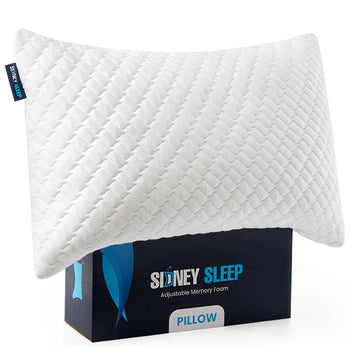




The short answer: side sleepers usually do best with a medium-firm to firm pillow, back sleepers with medium to medium-firm, and stomach sleepers with soft and low. But firmness is only half the question. A pillow also needs the right height (loft), and the two are not the same thing: a tall soft pillow can squash flat under your head, while a low firm one never gets tall enough. Choose the height first, then a firmness that holds it.
This guide explains what pillow firmness actually means, how it differs from loft, which firmness suits each sleep position and body, what the research says, how to test your own pillow, and how to make a pillow firmer or softer.
What pillow firmness means
Firmness is how much a pillow pushes back when you press into it. A firm pillow resists your head and keeps its shape. A soft pillow gives way and molds around you. Brands usually describe it on a five-step scale: soft, medium-soft, medium, medium-firm and firm. As Casper's guide points out, there is no universal metric behind those labels, so one brand's "medium" can be another's "firm."
Firmness comes from the fill and how much of it there is:
| Fill | Typical firmness |
|---|---|
| Down | Soft to medium |
| Down alternative / polyester | Soft to medium-firm, depending on how full it is |
| Feather | Soft to medium |
| Shredded memory foam | Medium-soft to firm, set by how much fill you leave in |
| Solid memory foam | Medium-soft to medium-firm |
| Latex | Medium to firm, with a springy feel |
| Buckwheat hulls | Firm to extra firm |
Firmness vs loft: why they get confused
Loft is how tall a pillow is. Firmness is how much it resists compression. They are separate, but they interact, because what matters is how tall the pillow is with your head on it.

Loft and firmness are different things. What matters is how tall the pillow is with your head on it.
- A tall, soft pillow looks high on the bed but sinks a long way under your head. It can end up lower than it looks.
- A tall, firm pillow stays close to its full height. This is what most side sleepers need.
- A low, soft pillow stays low and gives a lot. This is what most stomach sleepers need.
- A low, firm pillow stays low but doesn't give. Some back sleepers like this.
On an adjustable shredded memory foam pillow, the two move together: more fill makes it taller and firmer, less fill makes it lower and softer. See our guide to shredded memory foam pillows.
Firm pillows: pros and cons
Good: they hold their height through the night, give stable support, and tend to last longer because they resist flattening. They make it easier to move without your head sinking in.
Watch for: they can feel hard at first, can press on the ear and jaw for side sleepers, are usually too tall and stiff for stomach sleepers, and dense fills such as solid memory foam can feel warm. Harvard Health warns that "too high or stiff a pillow" keeps the neck flexed overnight and "can result in morning pain and stiffness."
Soft pillows: pros and cons
Good: they feel plush, mold easily, are comfortable from the first night and are easy to scrunch into shape. A soft, low pillow is often the right choice for stomach sleepers.
Watch for: they compress more under your head, so side sleepers often find them too low. They need more frequent fluffing and tend to flatten sooner.
Medium and medium-firm
Medium and medium-firm sit in the middle and suit most back sleepers and combination sleepers who switch positions. Several of the main guides recommend medium-firm for combination sleepers, and as the next step to try if a firm pillow feels too firm. Our Bamboo Curve arrives medium-firm, and you can make it softer by taking fill out.
Which firmness for your sleep position?
| Sleep position | Firmness | Height | Why |
|---|---|---|---|
| Side | Medium-firm to firm | High | Has to fill the gap between your ear and the mattress, and keep filling it |
| Back | Medium to medium-firm | Medium | Supports the curve of your neck without pushing your chin down |
| Stomach | Soft | Low | A firm or tall pillow pushes your head back while it is turned |
| Combination | Medium, or adjustable | Medium | A middle setting, or adjust for the position you use most |
Our guides to pillows for side sleepers and pillows for back sleepers go into each position in detail.
Other things that change the firmness you need
- Your size. Sleep Foundation notes that people with larger heads and wider shoulders will probably find a firmer pillow relieves more pressure, while a smaller head and narrower shoulders can do well on a softer one. If one shoulder hurts when you lie on it, see side sleeping with shoulder pain.
- Your mattress. This is where guides disagree. Some say a soft mattress needs a taller, firmer pillow. The card that comes with our pillows says the opposite: on a soft mattress, remove fill; on a firm mattress, add fill, especially if you sleep on your side. The reasoning: on a soft mattress your body sinks in further, which leaves less space between your head and the bed. Whichever way it goes for you, check your pillow on the mattress you actually sleep on.
- Heat. Dense, firm fills such as solid memory foam tend to feel warmer. Shredded fills let more air through. Our guide to whether memory foam pillows sleep hot explains why.
- Preference. Comfort is personal. A pillow that holds your head level but feels wrong to you won't get used.
What the research says about firmness
There is no study that settles firm versus soft for everyone, but a few results are worth knowing:
- In a 2010 trial, side sleepers each tried five pillows for a week. The springy latex pillow produced the fewest waking symptoms and the soft feather pillow the most.
- A 2021 systematic review and meta-analysis found latex (rubber) and spring pillows reduced neck pain for people with chronic neck pain, and that side-lying neck alignment depended more on a pillow's shape and height than its material.
- A 2025 systematic review found the evidence is still limited, with no pillow type (latex, foam or standard) showing clear superiority.
The takeaway: supportive fills that hold their shape tend to do well, but height and fit matter at least as much as firmness.
How to test a pillow's firmness at home
- The press test. Press your hand into the center and let go. A firm pillow pushes back quickly. Memory foam recovers slowly but fully. A pillow that stays dented is worn out.
- The ten-minute test. Lie in your usual position for ten minutes. If your head has slowly sunk toward the mattress, the pillow is too soft (or too low) for that position.
- The morning test. Waking up with the pillow folded, stacked on another pillow or with your arm under it usually means it is too soft or low. Waking with your neck feeling pushed or a sore ear can mean it is too firm or tall.

The press test: press into the center, let go, and watch how the pillow recovers.
Signs your pillow is too firm or too soft
| Too firm (or too tall) | Too soft (or too low) |
|---|---|
| Your head feels pushed up or tilted | Your head sinks toward the mattress |
| Pressure on your ear or jaw when on your side | You fold the pillow or stack two |
| You end up sleeping on the edge of the pillow | You push your arm under the pillow for height |
| Your neck feels bent forward on your back | It is flat by morning however much you fluff it |
Can you make a pillow firmer or softer?
- Adjustable pillows: yes, easily. Add fill for a firmer, taller pillow; remove fill for a softer, lower one. Change one handful at a time. Our guide to setting an adjustable pillow explains how much.
- Fiber, down and feather pillows: fluffing restores some firmness for a while. A pillow that won't firm up after fluffing is usually worn out. See how often to replace a pillow.
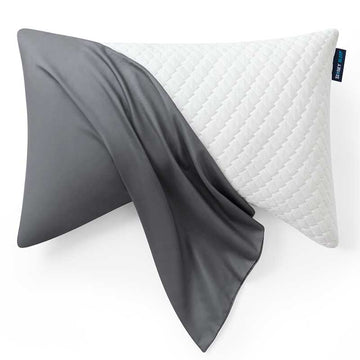
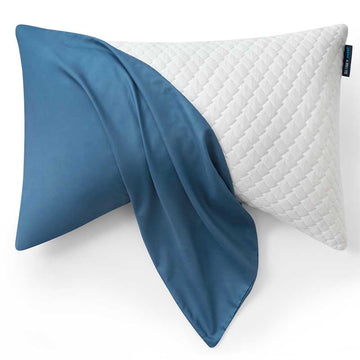
- Solid foam and latex: the firmness is built in. A softer pillowcase changes the surface feel slightly, but not the support underneath.
Firmness options at Sidney Sleep
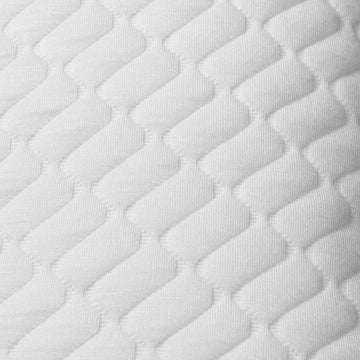
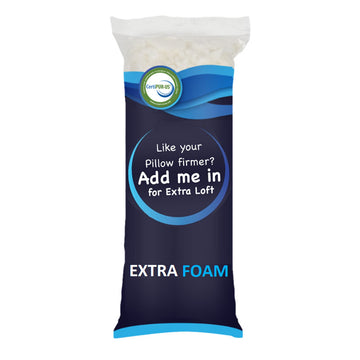
- Bamboo Curve: medium-firm out of the box. Its 75% CertiPUR-US® certified shredded memory foam and 25% polyester fiber fill sits in a zippered inner liner, so you can make it softer and lower by removing fill, or firmer and taller with the extra bag of foam included.
- Bamboo Classic: arrives quite firm because it is filled to full capacity, and you can remove foam through the inner lining for a softer, lower feel.
- Premium Hotel Pillows: a soft option, medium-plush with down-alternative fill.
Pillows ordered on sidneysleep.com come with a 100-night trial, which matters with firmness: it can take a few nights to know whether a pillow is right.
FAQ
Is it better to have a firm or soft pillow?
Neither is better for everyone. Side and back sleepers usually do better with medium-firm to firm, stomach sleepers with soft. What matters most is that the pillow holds your head level in the position you sleep in.
Do side sleepers need a firm pillow?
Usually firm or medium-firm, because they need a lot of height and a soft pillow tends to compress below it.
What firmness is best for neck pain?
There is no proven best firmness. Supportive fills that hold their shape did well in some studies, but height and fit matter as much. MedlinePlus advises contacting a health care provider if neck pain doesn't improve after a week of self-care, or comes with numbness, tingling or weakness.
Is firmness the same as loft?
No. Loft is height; firmness is how much the pillow resists compression. A tall soft pillow can end up lower under your head than a medium firm one.
Why does my new pillow feel too firm?
Many pillows, especially shredded foam ones, arrive fully filled. Let it expand, fluff it, then remove fill until it feels right.
Do firm pillows last longer?
Generally yes, because they resist flattening. Soft fiber and feather pillows tend to flatten sooner.
Sources
- Harvard Health Publishing. Say "good night" to neck pain. 2022.
- Gordon SJ, Grimmer-Somers KA, Trott PH. Pillow use: the behavior of cervical stiffness, headache and scapular/arm pain. Journal of Pain Research. 2010;3:137–145.
- Chun-Yiu JP, Man-Ha ST, Chak-Lun AF. The effects of pillow designs on neck pain, waking symptoms, neck disability, sleep quality and spinal alignment in adults. Clinical Biomechanics. 2021;85:105353.
- Ghosh S, Goyal M, Goyal K. Effect of pillow on pain, disability and sleep quality in patients with chronic neck pain: a systematic review. Rehabilitación. 2025;59(3):100922.
- Sleep Foundation. Best Pillow for Shoulder Pain (firmness and body size guidance). October 2026.
- Firmness scale and fill ranges also drawn from the firmness guides published by Casper, Saatva, Coop and Turmerry.
- MedlinePlus, US National Library of Medicine. Neck pain.
- Sidney Sleep product pages and pillow cards.


