







When you sleep on your side, there is a gap between your head and the mattress about as wide as your shoulder. A good pillow for side sleepers fills that gap, and keeps filling it all night, so your head stays roughly in line with your spine instead of dropping toward the mattress or being pushed up.
There is no single best pillow for every side sleeper, because shoulder width, mattress firmness and personal preference all change what works. What there is, is a short list of things the right pillow has to get right: height, firmness, shape and fill. This guide goes through each one, then shows you how to check the pillow you have.
What side sleepers need from a pillow
Harvard Health advises side sleepers to "keep your spine straight by using a pillow that is higher under your neck than your head," and to avoid a pillow that is too high or stiff, which keeps the neck bent overnight. In practice that comes down to four things:
- Enough height to fill the space between your ear and the mattress.
- Enough firmness to hold that height under the weight of your head, all night.
- Support under the neck, not just under the head.
- Not too much of either. A pillow that is too tall bends your neck the other way.
1. Height: fill the gap to your shoulder
Height (loft) matters more for side sleepers than for anyone else. Lying on your side, your shoulder lifts your head well off the mattress, so a flat pillow lets your head tip down. Side sleepers usually do best with a high-loft pillow, around 5 inches or more before you lie on it.
The right height for you depends on:
- Your shoulders. A 2021 review of pillow-height research lists the width from ear to shoulder as one of the key measurements for side lying. Broader shoulders generally mean more space to fill.
- Your mattress. On a soft mattress your shoulder sinks in, so you need less height. On a firm mattress you need more.
- Preference. The same review found there are still no firm conclusions about one optimal pillow height, which is a good argument for a pillow you can adjust.
Our guides to pillow loft and sleep positions and setting an adjustable pillow go into more detail.
2. Firmness: medium-firm to firm usually holds up best
A pillow can look tall on the bed and be flat by 3 a.m. Soft fills compress under the weight of your head, which takes away the height you need. That is why side sleepers usually do best with a medium-firm to firm pillow, or a soft-feeling pillow with enough fill in it that it does not flatten.
A quick test: if you often wake up with the pillow folded in half or your arm pushed underneath it, it is probably too soft or too low.
3. Shape: think about your neck and shoulder
Most pillows are a plain rectangle. Some are shaped with side sleepers in mind:
- Curved pillows have an inward curve along one long edge that fits around your shoulder, so the pillow can sit close in to your neck instead of being pushed away by your shoulder.
- Contour pillows are usually a solid block of foam with a raised edge for the neck and a lower dip for the head. They follow the "higher under your neck" idea, but they come at one fixed height.
Shape comes down to fit and preference. Height is still the thing to get right first.
4. Fill: which ones work for side sleepers
| Fill | How it feels | For side sleepers |
|---|---|---|
| Shredded memory foam | Supportive and moldable | A strong choice. In an adjustable pillow you can add or remove fill to set the height, and it holds its shape well. Needs a quick fluff now and then. |
| Solid memory foam | Firm, slow to respond | Holds its height well, but you cannot change that height. Some people find it warm. |
| Latex | Springy and responsive | Holds its height well; fixed unless the latex is shredded. |
| Down | Very soft and light | Usually too soft unless the pillow is very full. Compresses under your head. |
| Feather | Soft and conforming | Shapes to your neck, but Harvard Health notes feather pillows "will collapse over time" and should be replaced every year or so. |
| Down alternative (polyester) | Soft to medium, light | Choose a full one. It tends to flatten with use. |
| Buckwheat hulls | Firm and moldable | Holds its shape firmly and you can remove hulls, but it is heavy and rustles when you move. |
For a closer look at how the main fills compare, see our guide to memory foam vs down vs feather pillows.
How to check if your pillow is right
- Lie down in your usual position, on your own mattress, with your usual pillow.
- Ask someone to look at you from the front, or take a photo. Your head should be level: not tipped down toward the mattress or up toward the ceiling. Your nose should line up roughly with the center of your chest.
- Check your neck and shoulder. Your neck should not be bent to either side, and your shoulder should not be jammed up against the pillow.
- Notice what you do at night. Waking with your arm under the pillow, or the pillow folded over, usually means it is too low.
If your head tips down, you need more height. If it tilts up, you need less. On an adjustable pillow, change it one handful of fill at a time and give each change a night or two.
Other things that help side sleepers
- Look at your mattress too. It changes how much pillow height you need. See how your mattress can affect your sleep.
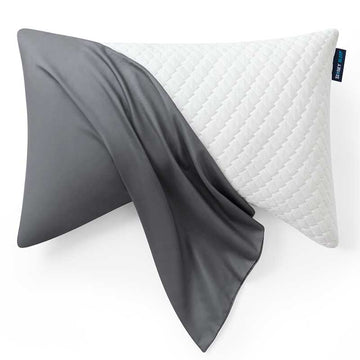
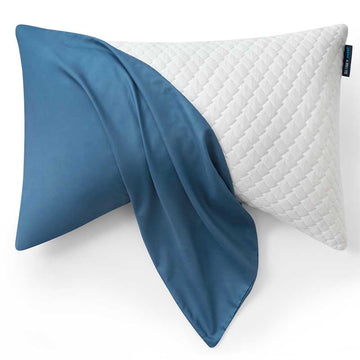
- Use a pillowcase that fits. A standard pillowcase can bunch up on a curved pillow. Our pillowcases are cut to fit curved side sleeper pillows, with a full-length zipper and soft brushed microfiber, in Queen, King and Travel Mini sizes.
- Replace a pillow that has gone flat. If it no longer springs back, it is probably not giving you the height it used to. Here is how often to change your pillow.
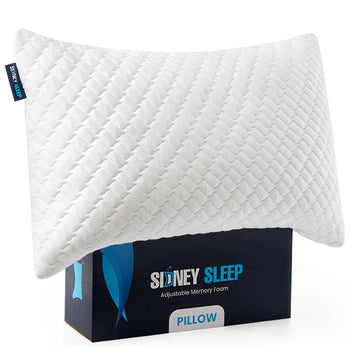
The Sidney Sleep Bamboo Curve: made for side and back sleepers
We designed our Bamboo Curve adjustable pillow around the points above:
- Height you set yourself: the fill is a blend of 75% CertiPUR-US® certified shredded memory foam and 25% polyester fiber, inside a zippered inner liner so you can add or remove fill. It arrives generously filled (medium-firm out of the box) and comes with an extra bag of foam in case you want it taller.
- Curved shape: the curve contours to your shoulders and centers your head on the pillow.
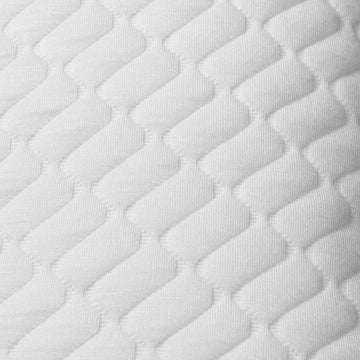
- Machine-washable bamboo-blend cover: the quilted outer cover comes off for washing.
- Three sizes: Standard (19 x 26 in), Queen (19 x 29 in) and King (19 x 36 in), plus the Bamboo Curve Mini travel pillow.
Pillows ordered on sidneysleep.com come with a 100-night trial and a 5-year warranty, so you have time to find the right height.
FAQ
What is the best pillow height for side sleepers?
Usually a high loft, around 5 inches or more before you lie on it. The exact height depends on your shoulder width and how far you sink into your mattress, so treat that as a starting point.
Should side sleepers use a firm or soft pillow?
Most side sleepers do better with medium-firm to firm, because a firmer pillow holds its height through the night. If you like a softer feel, choose a pillow with enough fill that it does not flatten under your head.
Are curved pillows good for side sleepers?
Many side sleepers like them, because the curve fits around the shoulder and lets the pillow sit close to the neck. Whether a curved pillow suits you still depends mostly on getting the height and firmness right.
What is the best pillow for side and back sleepers?
Side sleeping needs more height than back sleeping. If you switch between the two, an adjustable pillow lets you set a height in between, or set it for the position you spend the most time in.
Is it OK to use two pillows?
If one pillow is too low, stacking two can get you the height, but they tend to slide apart during the night. One pillow at the right height is usually more stable.
Sources
- Harvard Health Publishing. Say "good night" to neck pain. 2022.
- Lei J-X, Yang P-F, Yang A-L, et al. Ergonomic Consideration in Pillow Height Determinants and Evaluation. Healthcare (Basel). 2021;9(10):1333.


