







Waking up with a stiff or sore neck after a night on your side is common, and part of the cause is often simple: how your head and neck were supported for seven or eight hours. MedlinePlus, the US National Library of Medicine's health site, lists "sleeping in an uncomfortable position" among the everyday causes of neck pain.
This guide explains how your pillow setup can play a part, what a pillow has to do for a side sleeper, and how to check yours. It is not medical advice. If your pain is severe, follows an injury or comes with any of the symptoms listed further down, see a doctor.
Why does my neck hurt after sleeping on my side?
When you lie on your side, your shoulder lifts your upper body off the mattress, and your head needs something to fill the space between it and the bed. If that support is off, your neck can spend the night bent to one side. Common setup problems:
- The pillow is too low. Your head tips down toward the mattress and your neck bends sideways to follow it. People with broader shoulders run into this more.
- The pillow is too high or too stiff. Your head is pushed up instead. Harvard Health warns that too high or stiff a pillow "keeps the neck flexed overnight and can result in morning pain and stiffness."
- The pillow flattens during the night. A soft pillow that starts at the right height can compress under your head by morning.
- Your mattress changes the height. On a soft mattress your shoulder sinks in and a tall pillow becomes too tall. On a firm mattress the same pillow can be too low.
- You drift onto your front. Many side sleepers roll partway onto their stomach during the night. Harvard Health describes stomach sleeping as "tough on your spine, because the back is arched and your neck is turned to the side."
Neck pain has plenty of other causes too, from muscle strain during the day to conditions like arthritis, so a pillow is not always the answer.
What your pillow has to do
1. Fill the space between your ear and the mattress
A 2021 review of pillow-height research lists the width from ear to shoulder as one of the key measurements for side lying. The same review found there are still no firm conclusions about one optimal height, so expect a little trial and error to find yours.
2. Support your neck, not just your head
Harvard Health's advice for side sleepers is to "keep your spine straight by using a pillow that is higher under your neck than your head." A pillow that fills in under your neck stops it sagging into the gap above your shoulder.
3. Keep its height all night
Fills that compress easily lose height as the night goes on. Harvard Health notes that feather pillows conform to the neck easily but "will collapse over time." Memory foam and shredded memory foam tend to hold their shape under the weight of your head. Our guide to memory foam vs down vs feather pillows compares the fills.
4. Not overdo it
More height and firmness is not always better. If your head tilts up or your neck feels pushed, take some height away.
How to check your setup
- Lie down in your usual position, on your own mattress and pillow.
- Ask someone to look at you from the front, or take a photo. Your head should be level, not tipped down toward the mattress or up toward the ceiling, and your nose should line up roughly with the center of your chest.
- Notice what you do at night. Waking with the pillow folded in half or your arm pushed underneath it usually means it is too low.
- Change one thing at a time and give each change a few nights before judging it.
Our guide to pillows for side sleepers goes into height, firmness and shape in more detail.
Other things to try
- Start the night on your side or back. Harvard Health calls these the two positions that are easiest on the neck.
- Look at your mattress. It changes how much pillow height you need. See how your mattress can affect your sleep.
- Replace a pillow that has gone flat. Here is how often to change your pillow.
What the research does and does not say
There is less research on sleep posture and neck pain than you might expect. A 2019 scoping review in BMJ Open found only four studies that met its criteria. Across them, side lying was generally linked to fewer spinal symptoms such as waking pain and stiffness, but the authors concluded there were not enough high-quality studies to answer the question properly.
The pillow-height review reached a similar place: the basics are well supported (keep your head and neck in line, at a height that suits your body), but no one can give you your exact number. That is where a pillow you can adjust helps.
When to see a doctor
Changing your pillow is for everyday morning stiffness. MedlinePlus advises contacting your health care provider if, among other things:
- your symptoms do not go away in 1 week with self-care
- you have numbness, tingling or weakness in your arm or hand
- your neck pain was caused by a fall, blow or injury
- the pain gets worse when you lie down or wakes you up at night
- the pain is so severe that you cannot get comfortable
Seek medical help right away if you have a fever and headache and your neck is so stiff you cannot touch your chin to your chest, or symptoms of a heart attack such as shortness of breath, sweating, nausea, vomiting, or arm or jaw pain. See the full list on MedlinePlus.
Where the Sidney Sleep Bamboo Curve fits in
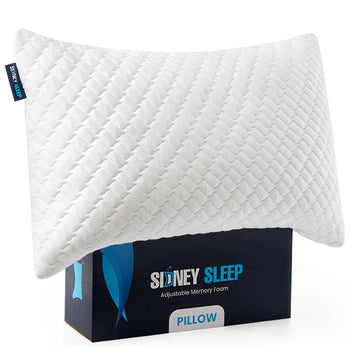
No pillow can promise to fix neck pain, and we don't claim ours will. What we designed the Bamboo Curve adjustable pillow to do is make the pillow part easier to get right:
- A height you set yourself: the shredded fill (75% CertiPUR-US® certified memory foam, 25% polyester fiber) sits in a zippered inner liner, so you can add or remove fill a handful at a time. An extra bag of foam is included. Here is how to set an adjustable pillow.
- Curved shape: the curve contours to your shoulders and centers your head on the pillow.
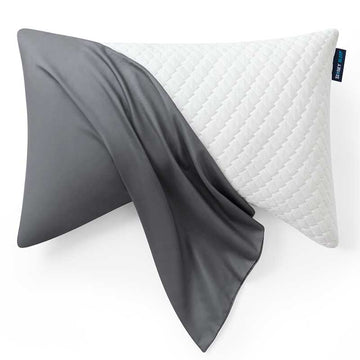
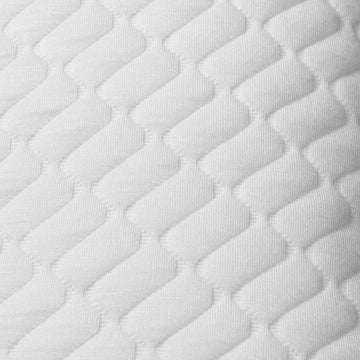
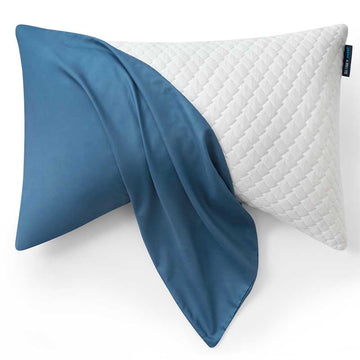
- Medium-firm out of the box, with a machine-washable bamboo-blend cover.
Pillows ordered on sidneysleep.com come with a 100-night trial, so you have time to find your setting.
FAQ
Why does my neck hurt after sleeping?
Often it is the setup: a pillow that is too low, too high or goes flat overnight, or a position like stomach sleeping that keeps your neck turned. Strain from the day before and other conditions can play a part too. If it lasts more than a week or comes with numbness, tingling or weakness, see a doctor.
What kind of pillow is best for side sleepers with neck pain?
No single pillow is proven best. Look for one that keeps your head level with your spine, supports your neck as well as your head, and holds its height through the night. An adjustable pillow lets you fine-tune that height.
Are curved pillows good for your neck?
There is little research on specific pillow shapes. A curved pillow fits around your shoulder so the pillow can sit close in to your neck, which many side sleepers prefer. Whether one suits you still depends mostly on its height and firmness.
Should I sleep without a pillow if my neck hurts?
If you sleep on your side, usually not. Without a pillow, your head drops toward the mattress and your neck bends to follow it.
How long does it take to get used to a new pillow?
Give it a few nights. If it still does not feel right, adjust one thing at a time, such as a handful of fill, rather than changing everything at once.
Sources
- MedlinePlus, US National Library of Medicine. Neck pain. Reviewed January 2026.
- Harvard Health Publishing. Say "good night" to neck pain. 2022.
- Cary D, Briffa K, McKenna L. Identifying relationships between sleep posture and non-specific spinal symptoms in adults: a scoping review. BMJ Open. 2019;9(6):e027633.
- Lei J-X, Yang P-F, Yang A-L, et al. Ergonomic Consideration in Pillow Height Determinants and Evaluation. Healthcare (Basel). 2021;9(10):1333.


